Although I had completed a similar type of research synopsis in last week’s post, it was incredibly liberating to receive feedback that I should search for multimedia sources rather than for articles in the UBC library catalog. Like many students my age, I was conditioned to use peer reviewed articles in academic research. The reality, however, is that I rarely employ this type of research in my everyday research for teaching. It was rather amusing that I was unknowingly awaiting permission to use videos and social media for research in a course on Media and Technology. In addition to the traditional published text resources I found last week, this is a collection of research that helped to orient my understanding of digital citizenship.
Rethinking Digital Citizenship
(ISTE, 2018)
I really enjoyed the video on rethinking digital citizenship by ISTE. The presenter, Richard Culatta, highlighted the precise challenges with teaching digital citizenship: an unclear definition of what it means and a lack of explicit instruction on authentic digital engagement. Culatta was inspiring and practical, and shared many nuggets that I will take away with me as I develop my school’s K-7 scope and sequence on Digital Citizenship.
In Culatta’s concise definition of digital citizenship, he extracts the core value of citizenship and places it in a digital context. For him, it was using technology to: make your community better; respectfully engage with people who have different beliefs than yours; be able to shape and change public policy; and be able to recognize the validity of online sources and information. Ultimately, these are ways to make student voices heard and to teach students to use technology for the greater good.
I also appreciated how Culatta framed digital citizenship as “not a list of ‘Don’ts’, but a list of ‘Do’s'” (2011). It helped me to recognize that teachers might be more occupied policing students’ usage of technology rather than helping students connect the dots between technology and social, thinking, and research skills. As Culatta points out, “Learning to be a good digital citizen is not what happens if you don’t actively teach it.” This advice mirrored what we learned from Will Richardson about doing real work for real audiences.
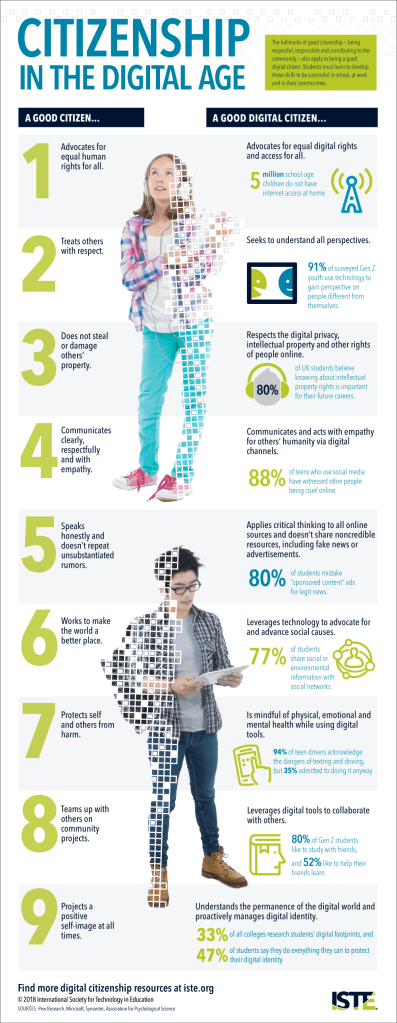
Culatta directs individuals to more resources from ISTE, which gave me the infographic below. It appropriately frames digital citizenship as “citizenship in a digital age,” which is a much clearer definition of digital citizenship than the term itself. I am also looking forward to exploring Digital Citizenship in Action by Kristen Mattson for further ideas on how to engage students in authentic digital contexts. I always try to bring hands on, real world applications of learning into the classroom and I simply have not been doing this enough in the digital realm.
Turning Digital Natives to Digital Citizens
T.E.D. Talks (2017)
ISTE’s inspiring video led me to search for more video presentations through T.E.D. It was important for me to hear a perspective from an individual outside of North America. Anne Mette Thorhauge highlights the incorrect assumption people make that digital natives know how to be digital citizens, using the example that today’s youth understand privacy on the internet, but have no concept of privacy on online platforms, internet providers, and servers. I was looking for a source that would challenge me and make me uncomfortable, and Thorhauge accomplishes this when discussing Facebook privacy accountability. As she assesses, “Using media is not the same as understanding the media, and understanding the media is [often] not even enough […because] some of the challenges posed by digital technology today cannot be met by media users being a little more careful. They need to met by digital citizens co-creating the future.” (2017).
The most powerful idea in Thorhauge’s TED talk was the idea of agency in digital citizenship. The power of the collective over the individual, staying informed of one’s rights, and using the principles of democracy to shape the future of the internet are all empowering concepts for digital natives AND digital immigrants.
Connected, but Alone?
Turkle (2012)
Sherry Turkle shares the psychology perspective on digital citizenship that I was seeking, and she addresses what feels like the elephant in the room when it comes to technology use: it leads to disconnection. This fact is one that is perhaps commonly known but that many people, particularly youth, refuse to acknowledge because of how psychologically powerful those little devices in our pockets are. “They not only change what we do, but who we are” (2012), Turkle suggests. She challenges people to examine the pervasive use of technology in scenarios we would have found bizarre a few years ago, including during board meetings, when a group of friends are spending time together, and even funerals. Her points confirm that our society not only has a technology addiction, but there is “trouble in how we relate to each other, and to ourselves. It hinders our capacity for self-reflection” (2012).
What I have been the most curious about is how to circumnavigate this minefield of mental health triggers in a world of growing disconnection, and she responds to this pointedly. It is only through conversation in real time, where we experience a loss of control, where we do not edit and filter our responses, and we allow relationships to develop richly with all its messiness. Her other noteworthy point about reconnecting as humans in a technology-rich world is to “start seeing solitude as a good thing” (2012). The irony of being connected online at all times is that we have developed a loneliness. I feel like these two recommendations for more face-to-face conversation and teaching children to be alone are feasible and reasonable, though I feel the need to continue researching more in this area of mental health in the digital sphere.
The Virtual Community
This podcast features an interview with Howard Rheingold who provides insights into the landscape of online communication since its inception. When this mode of communication first originated, it was entirely text-based. Yet, Rheingold addresses the need for people to reach out to each other as human beings and, through text communication, groups of people were able to band together and unite on a cause. Although the use of images, videos and interactive platforms have evolved the present mode of online communication, the defining qualities of community remain the same – rooted in a shared cause or experience.
Based on the interview, it appears the concerns with online spaces and have also persisted over the past four decades. Fortunately, so have the counterpoints to these concerns – media literacy and digital citizenship are at the heart of effective online communication and it will continue to be an area of utmost importance in school curriculum.
Teaching Digital Citizenship All Year
I discovered this blog post by Erin Flanagan through Pinterest. It brought forward the idea that Digital Citizenship education is curriculum that is continually ongoing, evolving, and relevant. She urges teachers to get in touch with the technology students are using because “if your lessons and discussions about digital citizenship are not tailored to your group, [students] will tune you out and your very sound advice seems inauthentic” (2017). She also suggests that teachers are doing a disservice to students if they only present “vetted school-based site with everything filtered and locked down” (2017), as they are not taught to think for themselves about searching, advertisements and credibility. As the T-L at my school, I have certainly felt it was my responsibility to complete the vetting process for students and staff and to only present the best quality sites to them. While I will continue to do this to save everybody time, I also need to provide everyone find opportunities to learn this process for themselves.
Conclusion
These resources will be pivotal in building a Digital Citizenship Scope & Sequence that aligns well with the strong foundation of design thinking and global citizenship at our school. I was very satisfied with the scope of my research, as I feel it is a holistic perspective on Digital Citizenship. Prior to this research, I had held Common Sense Media’s resources in high regard; however, I have a deeper understanding of how Digital Citizenship education is to produce engaged and caring citizens – not just effective users of today’s technology.
Works Cited:
Flanagan, E. (2017, February 22). TEACHING DIGITAL CITIZENSHIP ALL YEAR IN THE CLASSROOM. Retrieved September 28, 2019, from https://www.erintegration.com/2017/02/21/digital-citizenship-all-year/.
ISTE. (2018, October 11). Rethinking digital citizenship. Retrieved from https://www.youtube.com/watch?v=iwKTYHBG5kk
ISTE. (2017). Retrieved from https://www.iste.org/explore/Digital-citizenship/Infographic:-Citizenship-in-the-digital-age
Modern Learners. (2019, September 9). #70 – Virtual Community with Howard Rheingold. Retrieved from https://modernlearners.com/70-rheingold/.
Talks, T. E. D. (2017, December 5). Let’s turn our digital natives into digital citizens | Anne Mette Thorhauge | TEDxCopenhagenSalon. Retrieved from https://www.youtube.com/watch?v=M6cS9uR1NRA
Turkle, S. (2012, February). Connected, but alone? Retrieved from https://www.ted.com/talks/sherry_turkle_alone_together?referrer=playlist-our_digital_lives
 The Learning Circle
Wow! Excellent post with a plethora of amazing resources and connections to your topic. I was especially pleased to see you reference Turkle and Rheingold, both very astute thinkers on these topics and communities online. Your variety of resources and formats, the important topics and reminders, the excellent infographic and videos all add up to create a very powerful set of resources and references for your ongoing inquiry into implementation of digital literacy and citizenship. I also appreciated your discussion and reflection on how freeing it can be to explore outside of the traditional articles and journal format. Overall, a very well done Reading Review Part C.
LikeLike