The trait that makes me an ideal teacher-librarian is also my one of my worst. My brain won’t ever turn off. I am always information seeking for a better understanding, a new way, and revelations I never realized were available to me. I love to share this knowledge with others, even during my colleagues’ well-deserved holidays. While some enjoy some time without a single thought of work, there I am sending them emails, texts or DM’s, excitedly sharing a perfect connection to one of their units. For the most part, I have learned to set professional boundaries between my personal learning and others’ rest periods. I have also found that continually improving my IT skills is one way to fulfill my desire to immediately implement my learning without disturbing others.
I was recently at a Google Educator Workshop and it taught me a lot about the way I learn and how technology education should be. Working in a technology-rich learning environment, I have experienced first hand how simultaneously empowering and crippling technology can be when students are not equipped with adequate knowledge and executive functioning skills. I started off in the Level One workshop because I was nervous about being overwhelmed by technology. It became apparent quite quickly that I was bored because I stopped completing the step-by-step tasks the instructor was giving and doing other work on my computer instead. When the opportunity presented itself to “level up,” I was forced into paying more attention, felt more excited about learning, and also had the autonomy to play around with certain G+ suite features I found useful when others were learning tips for G+ suite features I would never use.
This was a good reminder for me that this is a pretty common way for digital natives to learn. Students want time to play with features because many of them can approach new technology without that inhibiting fear of losing their work or messing up the computer that people from different generations have. Outside of technology, they need to be introduced to new ideas that challenge them and get them thinking long after a lesson. I suppose this is my long-winded way of saying that all the informal and formal learning that I do, I take immediately back into my teaching practice. I love learning and I want to share that love of learning with the students in hopes of inspiring them to pursue their love of learning as well. Additionally, I do feel the need to make myself useful in the eyes of my colleagues. Although there is a high level of collaboration as a T-L, being a librarian can be an isolated role.
Conferences and Workshops
I have completed a BA, B.Ed, M.Ed at UBC and am currently working on completing my T-L certificate. In addition to taking courses at UBC, I attend about 3-5 professional development conferences per year. I regularly attend the annual BCTLA Conference and often take workshops related to digital citizenship, innovative uses of technology in the library (such as Virtual Fieldtrips), and diversity in media and literature.
As part of my role in the school, I also attend IB Conferences for both PYP and MYP, the ERAC IT4K12 Conference, and workshops led by Future Design School. The school is also supportive of me pursuing my interest and developing expertise in child attachment theory and Indigenous education, and I have attended the FNESC Conference and Neufeld Institute conferences on several occasions.
The school supports the idea that every teacher is a language teacher and has brought in Adrienne Gear to do workshops with Fiction and Non-Fiction Reading and Writing Power, and primary teachers and specialists have completed their OG certification.
Social Media
I have a specially curated Facebook, Instagram and – to a certain degree – Twitter account where I follow people for book reviews, best teaching practices, tips on child development. I am also passionate about following media channels such as Yes! Magazine that challenge privilege, bias, and advocate for social justice.
I am always hesitant to engage in discourse with strangers online. This has simply not been my mode of engaging in social media. I will engage with friends on our personal accounts about political and educational issues; I may occasionally post comments of support and enthusiasm on public accounts, but I am not comfortable “putting myself out there” and stating an opinion that I know will be attacked, even when I am certain I am correct. Therefore, these reservations have caused me to never develop digital relationships with like-minded educators. This is certainly an area for growth for me, and I get the sense that Twitter might be the best platform for this because there isn’t as much emphasis on visual content. I’ve noticed that the accounts I am interested in following on Twitter also differ from the accounts I follow on Instagram and Facebook. I tend to learn through imitation and I hope through following and connecting with the right balance of accounts in Twitter, I can refine my usage of that platform to develop more professional networks with book sellers, educational and technology thinkers, and credible news channels. I think learning to engage with others online is a skill that I can both model and learn alongside my students to practice the advice shared by Will Richardson (2012) to talk to strangers, since “the reality is that the kids in our schools will interact and learn with strangers online on a regular basis throughout their lives.”
Professional Networks
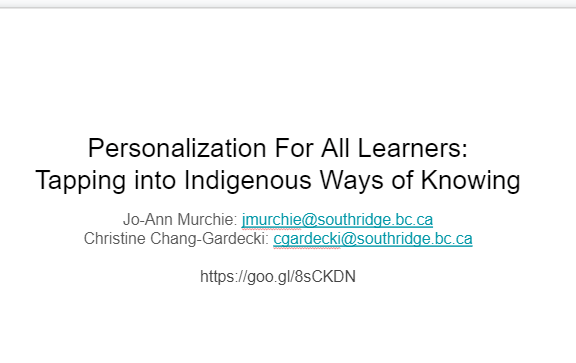
As part of the ISABC, there is a teacher librarian network which collaborates and meets twice per year. We discuss various topics related to libraries and share resources. I wouldn’t say that I am actively involved beyond attending the meetings. However, I did challenge myself to lead a workshop at our annual ISABC Conference in 2017 on Indigenous Ways of Knowing. Although I feel confident sharing my knowledge with my colleagues, it was definitely out of my comfort zone to address an audience of strangers. I would definitely consider another opportunity like this, but the topic and climate need to be right. Again, it would only come from a need to share information that I feel very knowledgeable about that I feel needs to be clarified for a greater audience. My current topics of passion are: the problems with our current economy and its ecological impact, curbing consumerism, and nurturing a connection with nature.
We have a professional reading book club at work, which I participated in until recently. We have read a variety of books including Alfie Kohn’s Punished by Rewards, Tony Wagner’s Global Achievement Gap, and Elena Aguilar’s Onward: Cultivating Emotional Resilience in Educators. The area where I am most lacking for my personal learning is networking. Admittedly, in my professional realm, I like to stick with those who I have been able to rely on and I do not expand that circle rapidly. I have never been a networker, collecting professional acquaintances like a young adult collects stamps in a passport. I have a circle of experienced teachers and T-L’s as mentors, a connection with a literature professor and someone in the book trade, and younger T-L’s to grow with. I find it difficult to carve out time and energy to expand beyond this.
Outside of education, I try to stay involved in the literary community. This past year, I was a judge for the Christie Harris Illustrated Literature BC Book Prize. It was a tremendous opportunity to read a variety of works, and it was a thrill to attend the gala with so many literary icons from our province in attendance. I love to attend events through the Vancouver Children’s Literature Roundtable and author talks organized by Kidsbooks. Through my children, I am a regularly user of the Vancouver Public Libraries and am always inspired by the various events and offerings they have, including The Human Library, The Indigenous Storyteller in Residence, and their historical photos collection.
I also think a large piece of expanding my professional learning is to start investing energy into topics that I am not as interested in. As a lifelong learner with a deep appreciation for different ways of knowing, I am interested in a lot of people, places, and stories, but there are certainly gaps and areas where I have a difficult time expanding my knowledge. One simple example is my lack of interest in the fantasy genre. Although I read A LOT of children’s literature, inclusive of picture books, graphic novels, middle grades and YA, I do gravitate towards realistic and historical fiction. I rely on students to share their current fantasy favourites when making recommendations to other students. I have never finished a single Harry Potter novel. To me, this is a large bias which I have never confronted. The more I can learn about things that I am not intrinsically motivated to learn, the more I can empathize with my students who are often in a similar situation. And empathy can only make someone a better person and teacher.
Works Cited:
Richardson, W. (2012). Why School?: How Education Must Change When Learning and Information Are Everywhere. TED Conferences Publishing. [EBOOK]
 The Learning Circle
Wow, this is a detailed, comprehensive and authentic and personal reflection on your ongoing professional development. You have described and discussed many useful strategies, approaches and opportunities for professional development all year long. You do so many right things, from attending conferences, connecting online, presenting, sharing and building respectful relationships with your colleagues. I understand the hesitation about interacting and connecting with others online, but I think you can be re-assured that most likely you will never be attacked for your personal ideas or feelings and if you do, there is always the “block” option for trolls! There are so many amazing educators and T-Ls online, its useful to think of your networks as layers of an onion, you will always have your core, key resources, colleagues and friends, but adding a layer of acquaintances, colleagues and professional connections can be just as validating. Great post.
LikeLike
Thank you for the encouraging words. In my job, I not only try to do the right thing but I also try to do what I would appreciate most in a T-L! I do like the onion metaphor. It’s a great reminder that there are more good people in the world than trolls. I guess I can learn to develop thicker skin and also peel back a moldy layer when I need to!
LikeLike
Holy smokes you are an inspirational person! So impressive how many conferences and pro-d’s you do! I also want to echo Aaron and encourage you to interact with more social media platforms. The small amount of times I have done it I have been so inspired (i am encouraging myself as well, lol). I can’t imagine most of them will have the feared trolls you so often hear about. So many things I want to comment on! Here’s my random list
1. I’m also not into Fantasy, and I’ve also never read Harry Potter! And my students FREAK OUT about it. I know I should. I have a bias against YA in general that I know I need to rectify so I can be the best TL for my future student readers one day. I have started including a mini fantasy unit in my CW english 11 class, and I have a grudging appreciation for the genre now, sort of…I still really don’t want to have to slog through those massive books tho!
2. I also love going to all the literary festivals I can (I used to go to Galiano every year-loved it) and being involved and making connections with the writer/literary community (in the hopes that one day i will actually write that damn novel I swear is somewhere inside of me…). Thanks for the reminder of all the amazing things that the VPL does.
3. I also love that you have a professional reading club at work! The best! I would like to institute that when I start working at a library one day. For now, with my marking and school and my own personal book club, I’m not sure I would have time, as much as I hate to admit that.
4. I would love to know more about what you presented on for that conference! Sounds fascinating.
5. I ‘lol’d at this line: “For the most part, I have learned to set professional boundaries between my personal learning and others’ rest periods”. I could see myself having this problem, hahahaha. I certainly have it in my personal life :p
Thanks again for such a great read!
LikeLike
Thank you for the encouragement! I will definitely try to interact more (while trying to manage my own screen time). I’m glad you enjoyed the post.
Regarding my presentation: Because of my background studying ecojustice, sustainability and indigeneity coinciding with the new Indigenous focus in the BC Ministry curriculum, I wanted to take away teachers’ fears about it and avoid tokenistic teaching. I tried to bring the conversation back to personalizing curriculum through unwritten narratives. I linked the presentation in my post and I think you should be able to click on the slides.
LikeLike
Your commitment to professional development is evident in your post. I’m amazed what you can take on, I’m was relieved to hear you mentor others, because as I was reading your post I kept thinking at how valuable you would be as mentor to others within your district.. The topics you mentioned: “the problems with our current economy and its ecological impact, curbing consumerism, and nurturing a connection with nature” are heavy on my mind as well. Here is a heartwarming read on the benefit of having that hands on connection with nature, that my administrator shared this weekend.
https://heartmindonline.org/resources/the-dirt-on-calm?utm_source=%3E+Dalai+Lama+Center+Subscribers&utm_campaign=7e432f9888-EMAIL_CAMPAIGN_2017_03_21_COPY_01&utm_medium=email&utm_term=0_82bc946c0d-7e432f9888-97281725
LikeLike
Thank you for sharing that link. It reminds me of this adorable little book: https://tinyurl.com/yy927tc9
Also, thank you for your encouraging words. I humbled to even be considered a mentor, as I am only in my second year as a T-L – though I do feel this is where I belong!
LikeLike