When I consider world libraries and access to resources in non-industrialized countries, I am of two minds. I most certainly believe in improving access to information through diverse means, and libraries should be a community space for citizens to gather and learn. However, as someone who also has a strong belief in disruptting systems of oppression, I approach this debate with caution. I am mindful of how Western societies project our version of reality to societies in other regions of the world – regions that have large populations of Indigenous people who still live as traditional societies. The idea of proposing a mobile library to non-industrialized countries prioritizes a particular type of knowledge, and I am concerned with how these differing values and societal structures undermines traditional knowledge keeping. My thoughts also wander to the degrees of corruption and the disparity in wealth that exist in these regions and how library access might be distributed among different socio-economic classes. With these considerations, my starting point for discussion and research is whether there is a universally agreed upon definition of a library and its function.
From my cultural perspective, the above video summarizes the role of a library aptly. However, when I think critically about it, the mere notion of a library being a place to help someone find a job is a very industrialized concept. I think back to the powerful film, Schooling the World (2010) featuring many big names such as Carol Black, Wade Davis and Helena Norberg Hodge who present evidence on how Western education has negatively impacted traditional societies. We make a grand assumption that Western versions of schools and, by extension, libraries are places for knowledge growth. The reality is that when such institutions are established in traditional societies, children are taught scientific concepts, such as flora and fauna, that do not pertain to any aspect of their local lives. They have difficulty finding work because their society is not rooted in industrial employment, then return home to their societies with little traditional knowledge of how to grow food and sustain themselves in their climate. Before planning a library for any society, one must always consider their cultural priorities. Some countries may continue to solely prioritize academic learning in their libraries while others need to prioritize local knowledge and keep their traditions intact. It has been difficult for me to respond to this week’s topic without feeling like I am making grand assumptions about society, knowledge, and betterment of life, and it has taken me by surprise how tumultuous my thoughts have become of libraries, library services, and resources.
An Encouraging Co-Existence
This brief video packs a punch and is a great example of how libraries can be of service in Western societies that co-exist with traditional societies. Language preservation is essential to the preservation of a culture, and it’s wonderful to hear that this is happening in the South Pacific.
In order for libraries to be successful in non-industrialized nations, local people must have agency and representation. In a random investigation of libraries in capital cities, examples from Kenya and Cambodia cited a lack of funding and staff. They seem to operate through donations, but with foreign-motivated involvement (eg. France contributing to the preservation of colonial documents in Cambodia, weeded books from Western libraries being sent to other parts of the world) it’s questionable how much quality material is being housed in these collections and how much local knowledge is being preserved in the libraries. Fortunately, libraries do extend beyond walls and can be measured by more than a physical collection and I do believe the merit of the digital library space is invaluable to all societies as we learn to become digital citizens of the world.
The Argument for Digital Libraries
In this older video, Brewster Kahle (2007) brings together the main notion of a library and how it can help industrialized and non-industrialized societies: universal access to all knowledge. It’s great to hear that over ten years ago, people from countries all over the world were already trying to scan books, record audio, and archive films. It’s a great reminder of the need to actively seek out diverse perspectives and voices and bring them into our libraries because, as Ann Morgan (2015) proves, they are out there if we connect with real people.
Innovative Libraries
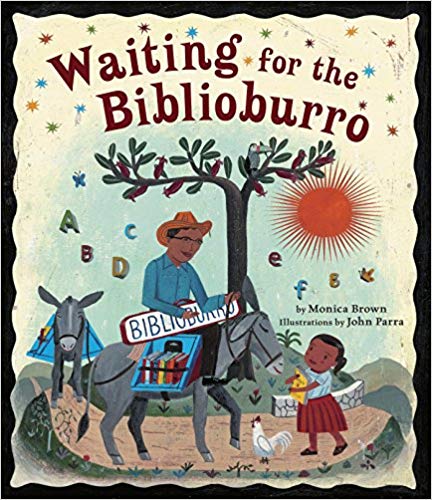
Mobile libraries are novel and practical. I’ve heard of the biblioburro in Colombia, as well as donkey-mobile libraries in Ethiopia, Zimbabwe and other parts of the continent. There is great enthusiasm for how mobile libraries increase literacy. Although not a library, locally, Iron Dog Books is a mobile bookstore run by an Indigenous pair that focuses on access by providing low-cost books and giving back to the Indigenous community.

This post outlines four examples of how innovative libraries can be personalized to meet the needs of a community. It was great to see the example from Africa, and how a knowledge centre was created to “help people with day-to-day problems like increasing crop yields, dealing with pests, and accessing health information” (Higgins, 2013). I’m particularly excited about this because it is where the name of my blog came from; I always strive to make learning relevant and provide real world contexts for all knowledge. The organization behind these knowledge centres, Arid Lands Information Network (ALIN), has been awarded an Access to Learning Award by the Gates Foundation and it is a true example of empowering communities with local knowledge. A common thread in world libraries is that they are remain a place for gathering. Even in Metro Vancouver, many of our libraries are located within community centres and they are certainly well-used.

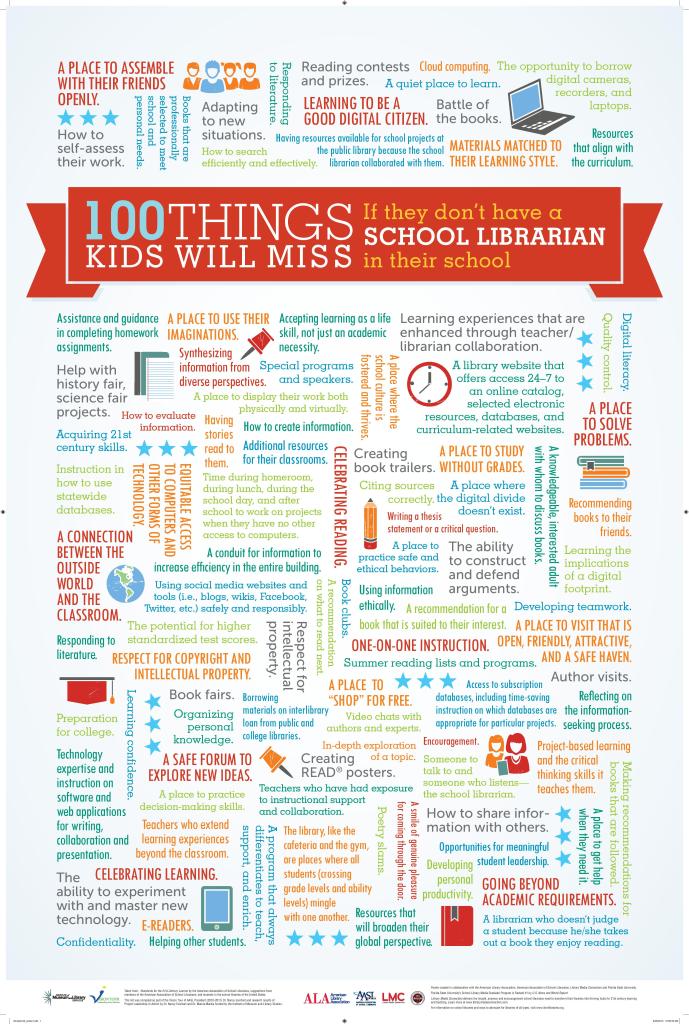
While considering all these visions and versions of libraries, I wanted to debate whether one “analog” feature of a library can ever be replaced digitally: the librarian. I have always loved this poster from the ALA regarding the school librarian and the space that is created for learners. Interestingly, I had one of my students tell me this past week that school librarians are different from regular librarians because we do more, but I wanted to come to the defense of all librarians because I feel it is one of the most misunderstood, underrated roles in society. The fact that we are even having this conversation about world library access demonstrates the behind-the-scenes advocacy librarians do and that we really are providing a public service for the betterment of society, regardless of how that might look. To me, having someone like this visibly on someone’s side is invaluable…but I’m also willing to admit that I might be the slightest bit biased.
Works Cited:
American Library Association, American Association of School Libraries, Library Media
Connection, & Florida State University. (2013). Retrieved from
http://www.ala.org/aasl/sites/ala.org.aasl/files/content/aaslissues/advocacy/100_Things_Poster.pdf
Black, Carol. (2010). Schooling the world: The white man’s last burden: A discussion guide and companion to the film. Retrieved from: http://schoolingtheworld.org/film/discussion-guide/
Higgins, C. (2013, September 4). Retrieved from Higgins, C. (2013, September 4). 4 Innovative Libraries Transforming Lives Around the World. Retrieved from http://mentalfloss.com/article/52525/4-innovative-libraries-transforming-lives-around-world.
Kahle, B. (2007, December). Retrieved from https://www.ted.com/talks/brewster_kahle_builds_a_free_digital_library?language=en.
Morgan, A. (2015, September). Retrieved from https://www.ted.com/talks/ann_morgan_my_year_reading_a_book_from_every_country_in_the_world.
N., Hurst, J., & Grossman, M. (Producers). (2010). Schooling the world: The white man’s last burden. [Film]. Telluride, CO: Lost People Films. [Shown in class]
PublicLibraryOnline. (2016, December 7). Retrieved October 28, 2019, from https://www.youtube.com/watch?v=OUPaKBACIUQ&t=3s.
State Library of New South Wales. (2017, April 27). Retrieved October 28, 2019, from https://www.youtube.com/watch?v=Ng6DZhTPr10.
 The Learning Circle
Very well done discussion post on the purpose, rationale, impact and goals of Libraries in our world. Your very high level exploration of the concept of a library and the different lenses we apply (inherently, or purposefully) can impact the goals, adoption and impact greatly. Appreciate all the videos, connections, thoughts and examples of ways that real world learning, as supported and facilitated by Libraries and Librarians can be a life changing experience. Overall, this was very well researched, discussed and shared.
LikeLike
Thank you for the feedback, Aaron. I’m glad you appreciated the post. Sometimes it feels like my thoughts on a subject go so far that I’m uncertain if I am straying off topic. I always feel the need to challenge my own worldview, particularly when discussing other parts of the world.
LikeLike